

At Balaved Pediatric Ayurcare, we focus on supporting children’s growth, immunity, digestion, daily routines, and overall well-being through individualized Ayurvedic pediatric care, healthy lifestyle practices, and parent-guided developmental support.

Baal Panchakarma – Ayurvedic Detoxification & Supportive Care
Baal Panchakarma refers to age-appropriate Ayurvedic procedures selected by a qualified practitioner according to the child’s age, constitution, health status, and specific needs.
Our approach may include:
Abhyanga (therapeutic oil massage): Gentle, age-appropriate oil massage when suitable, as part of a supervised wellness plan.
Swedana (selected forms of fomentation): Carefully assessed warming procedures when clinically appropriate.
Nasya and other specialized procedures: Considered only in selected cases following professional assessment.
Individualized Ayurvedic care: Procedures are chosen according to the child’s condition rather than applying the same protocol to every child.
Post-procedure guidance: Advice on hydration, food, rest, and home care as appropriate.
Our priority: Child safety, comfort, and gentle, individualized care. Panchakarma procedures are not suitable for every child; intensive cleansing, induced vomiting, purgation, and enemas should not be used routinely in children
Diet Charting According to Body Type & Season
We provide personalized dietary guidance that combines Ayurvedic principles with children’s nutritional requirements to support healthy growth and eating habits.
What our diet planning includes:
Prakriti-oriented guidance: Considering the child’s Ayurvedic constitution alongside appetite, digestion, activity, and individual tolerance.
Seasonal diet planning (Ritucharya): Adapting food choices to the season, weather, and availability of fresh foods.
Age-appropriate nutrition: Planning meals according to age, growth needs, and nutritional requirements.
Digestive wellness: Encouraging regular meals, suitable food variety, adequate fluids, and fiber-rich foods.
Healthy weight and growth support: Identifying dietary gaps and supporting appropriate growth with balanced nutrition.
Picky eating guidance: Helping parents develop calm, structured mealtimes without force-feeding or screen-dependent feeding.
Food sensitivity assessment: Reviewing suspected triggers and recommending appropriate medical evaluation when necessary.
Our goal: To help parents build sustainable, nutritious eating habits that support growth, energy, digestion, and overall wellness.

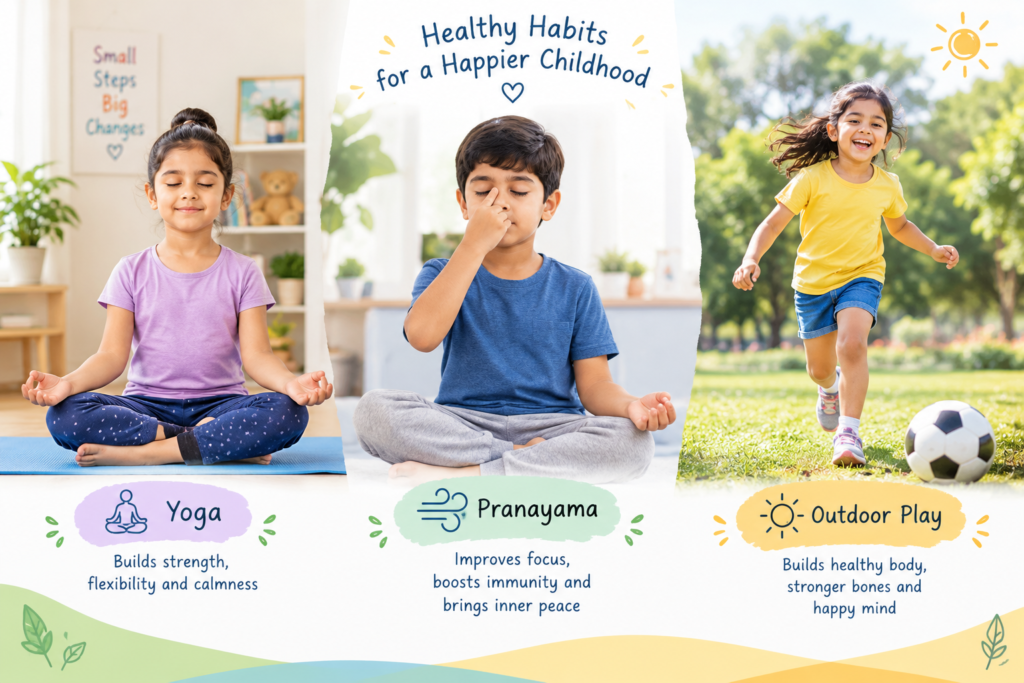
Yoga, Pranayama & Outdoor Play Encouragement
Movement, play, and relaxation are important parts of a child’s healthy development. We encourage age-appropriate activities that can be incorporated into everyday family life.
Our activity guidance includes:
Children’s yoga: Simple stretching, balance exercises, and playful yoga poses suitable for the child’s age and ability.
Pranayama and breathing awareness: Gentle, playful breathing exercises without forceful breath retention or strain.
Outdoor play: Encouraging running, jumping, ball games, cycling, and free play in a safe environment.
Sensory-motor experiences: Activities involving movement, touch, balance, and exploration.
Social interaction: Group games that encourage sharing, turn-taking, imitation, and cooperation.
Parent-child play: Simple activities that strengthen bonding and encourage communication.
Our goal: To promote physical activity, coordination, confidence, emotional regulation, and meaningful social interaction.
Lifestyle Correction – Dinacharya for Children
A consistent daily routine can help children develop healthier sleep, eating, activity, and self-regulation habits.
Our lifestyle guidance includes:
Healthy sleep routines: Age-appropriate bedtimes, consistent wake-up times, and calming bedtime habits.
Morning routines: Encouraging regular waking, personal hygiene, breakfast, and natural daylight exposure.
Meal-time discipline: Establishing predictable meal and snack times while respecting hunger and fullness cues.
Digestive health habits: Supporting regular physical activity, adequate hydration, and comfortable toilet routines.
Emotional well-being: Encouraging warm parent-child interaction, storytelling, and relaxed family time.
Personalized routine planning: Adjusting schedules according to the child’s age, school timings, sleep patterns, and family needs.
Our goal: To create a balanced daily rhythm that supports physical health, emotional well-being, and age-appropriate development.


Screen-Time Reset Planner – Enhancing Real-World Connection
Excessive screen use can displace opportunities for face-to-face interaction, language practice, imaginative play, movement, and sleep. Our screen-time reset planner helps parents create healthier digital habits while increasing meaningful real-world experiences.
What our planner includes:
Screen-use assessment: Understanding when, why, and how long a child uses screens, including during meals, crying, travel, and bedtime.
Personalized reduction plan: Creating realistic, age-appropriate steps to reduce recreational screen exposure.
Screen-free meal routines: Helping children reconnect with food, hunger cues, family conversation, and independent eating.
Communication-building activities: Encouraging imitation, naming, gestures, shared attention, storytelling, and conversational turn-taking.
Play-based engagement: Replacing screen time with puzzles, blocks, drawing, pretend play, music, and outdoor activities.
Emotional regulation strategies: Helping parents respond to screen-related tantrums with predictable boundaries, empathy, and suitable alternatives.
Sleep routine correction: Establishing screen-free wind-down time and a consistent bedtime routine.
Progress tracking: Monitoring screen use, sleep, communication opportunities, play, and family interaction.
Our goal: Not merely to reduce screen time, but to increase the child’s opportunities for connection, communication, play, and learning in the real world.